Abstract
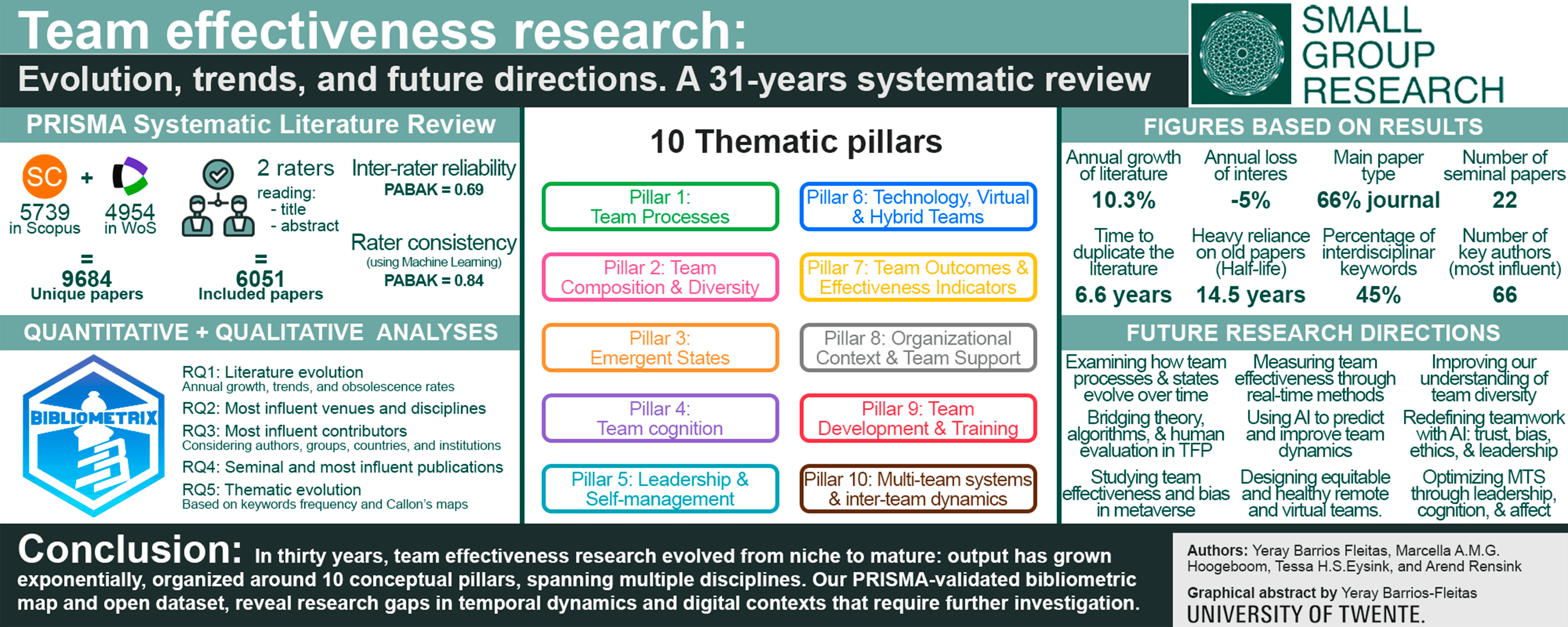
The widespread use of teams across society has driven interest in understanding team effectiveness. Prior reviews often focus on specific disciplines or contexts (e.g., sports or medicine). Using systematic bibliometric protocols enriched with machine learning, this study synthesizes 6051 peer-reviewed publications from Scopus and WoS, covering 1992–2022, to examine the evolution of team effectiveness research, key contributors, influential publications, and emerging trends. Results reveal exponential growth, and co-authorship, co-citation, and co-word analyses identified influential venues, authors, publications, and 10 thematic pillars: TEAM PROCESSES, TEAM COMPOSITION & DIVERSITY, EMERGENT STATES, TEAM COGNITION, LEADERSHIP, TECHNOLOGY, VIRTUAL & HYBRID TEAMS, TEAM OUTCOMES & EFFECTIVENESS INDICATORS, ORGANIZATIONAL CONTEXT & TEAM SUPPORT, TEAM DEVELOPMENT & TRAINING, and MULTI-TEAM SYSTEMS & INTER-TEAM DYNAMICS. Emerging trends include AI integration, adaptive leadership in diverse environments, and conflict resolution in virtual or hybrid teams. The study offers a roadmap for future research and an open-access resource for scholars.
Figures
This section shows the bibliometric figures used in the paper. Note that the data may differ from those observed in the paper, as these are updated periodically to extend the useful life of the analyses.
How has the number of papers grown over the years?
The bibliometric results indicate that team effectiveness literature, encompassing a total of 6,051 publications, has experienced significant growth from 1992 to 2022. FIGURE 3 shows that journal articles dominate the landscape, constituting 66% (3,987 publications) of the corpus and averaging around 127 publications annually. Publications at conferences followed a similar upward trend until 2008, when production stabilized with a slight downward trend. The cumulative markers at 25%, 50%, and 75% (i.e., vertical black flags) highlight an acceleration in scientific production.
The observed growth follows a broadly exponential pattern consistent with Price's Law (1963). Until 2002, when the first key publications established the foundation of the research field, the growth was gradual. However, between 2002 and 2022, (and despite a slight slowdown between 2012 and 2017), there was a significant acceleration that highlighted the emergence of the field as a significant research front, reaching a historic peak of 431 publications in 2021. The annual exponential growth rate was calculated at 10.3%, indicating that the volume of publications doubles roughly every 6.6 years, a faster pace than the 10-15 years reported by Price (1965). Additionally, exponential and third-degree polynomial models were fitted, both showing a strong fit, with R^2 values of 0.85 and 0.975 respectively (see FIGURE 3). However, it is important to recognize that these models are primarily descriptive and not predictive.
What are the most used keywords per thematic pillar
While the temporal analysis of keyword trends provides valuable insights into the shifting priorities of team effectiveness research over time, it remains necessary to move beyond isolated terms and identify broader conceptual patterns. To address this, we conducted an inductive classification of the most frequent keywords based on their conceptual proximity and thematic coherence. Keywords were iteratively grouped into thematic clusters. When a keyword could not be meaningfully integrated within existing clusters, a new thematic pillar was created. This approach resulted in the identification of ten meta-themes or thematic pillars that, together, capture the conceptual structure of the field and synthesize its major research streams (see TABLE 3). Each thematic pillar is accompanied by the 10 keywords most frequently used by the authors of the papers in this review
Table 3: Most used keywords classified in Thematic Pillars
Rank | Pillar 1 | Freq. | Pillar 2 | Freq. | Pillar 3 | Freq. | Pillar 4 | Freq. | Pillar 5 | Freq. | Pillar 6 | Freq. | Pillar 7 | Freq. | Pillar 8 | Freq. | Pillar 9 | Freq. | Pillar 10 | Freq. | |
|---|---|---|---|---|---|---|---|---|---|---|---|---|---|---|---|---|---|---|---|---|---|
No records to display | |||||||||||||||||||||
Which research areas and disciplines have the greatest influence on team effectiveness literature?
The identification of the most influential research areas and disciplines in team effectiveness yielded the ranking shown in FIGURE 5, which lists the 24 most influential research areas. Since a publication can belong to multiple research areas simultaneously, the count of publications in the figure exceeds the overall count of publications in this study.
A significant majority of the reviewed publications falls within the social sciences discipline, accounting for 49%. However, it is worth noting that the Engineering and Technology discipline is growing slightly faster than the social sciences discipline, with an increase of 12.5% annually, which is also reflected in the cited half-life of this discipline, which is 4 years on average in contrast to the average of 6 years for social sciences.
Which journals and conferences have the greatest influence on team effectiveness literature?
The table’s results show a clear imbalance in the representation of generalist and specialized journals addressing team effectiveness, with a higher number of generalist journals dominating the top-ranked positions. This imbalance reflects distinct patterns of fragmentation and convergence within venues. Fragmentation refers to the thematic and methodological diversity seen in generalist journals, such as ACADEMY OF MANAGEMENT JOURNAL, MANAGEMENT SCIENCE, and JOURNAL OF APPLIED PSYCHOLOGY, which publish studies from multiple disciplines and approaches. In contrast, convergence occurs in highly specialized journals such as SMALL GROUP RESEARCH and GROUP DYNAMICS, which synthesize and consolidate mature ideas, creating cohesive perspectives on team dynamics and effectiveness. Interestingly, some specialized journals, such as GROUP AND ORGANIZATION MANAGEMENT and TEAM PERFORMANCE MANAGEMENT are positioned as multidisciplinary, integrating research from disciplines such as Life Sciences, Engineering & Technology, and Arts & Humanities, making them ideal platforms for research that connects team dynamics with diverse contexts and practical applications, such as analysing teams in technological or health environments.
Conferences, meanwhile, offer unique platforms for incubating emerging research and exploring interdisciplinary approaches. Within this diverse ecosystem, some conferences stand out for their clear focus on team research. Examples include the CONFERENCE ON RESEARCH ON MANAGING GROUPS AND TEAMS, which directly addresses team dynamics and management; the HUMAN FACTORS AND ERGONOMICS SOCIETY (HFES) Conference, which includes significant content on teams in work contexts; the INTERNATIONAL CONFERENCE ON COMPUTER-SUPPORTED COOPERATIVE WORK (CSCW), focused on technology-mediated collaborative work; and the CONFERENCE ON HUMAN FACTORS IN COMPUTING SYSTEMS (CHI), where interactions and collaborations in technological systems are explored.
Table 4-A: Journals
R | Journal Title | LHI | TP | TC | Research Area | |
|---|---|---|---|---|---|---|
No records to display | ||||||
Table 4-B: Conferences
R | Conference Title | LHI | TP | TC | |
|---|---|---|---|---|---|
No records to display | |||||
Are there keywords that are used primarily in a specific discipline?
The results of the prevalence analysis also show that 45.61% of the keywords have a multidisciplinary nature, influenced not only by their applicability, but also by factors like technological advances, cultural shifts, and emerging priorities. COMMUNICATION has been a central term since 1993, starting in Social Sciences and Engineering and expanding to Life and Health Sciences by 2000. Its steady adoption highlights its integrative role across disciplines. SIMULATION began in Social Sciences in 1996 and spread to Engineering and Health Sciences by 1999, but its widespread use only emerged after 2007, likely due to technological advancements or shifting academic priorities. LEADERSHIP was adopted almost simultaneously across disciplines, except for Engineering in 1999 and Physical Sciences in 2011, reflecting differences in disciplinary focus on human dynamics. VIRTUAL TEAMS appeared in Engineering in 1996 but was not adopted by other disciplines until 2003, suggesting it initially addressed specific technical needs before gaining broader relevance. DIVERSITY emerged in 1992 in Social and Life Sciences, gradually expanding to the Humanities in 1998, Engineering in 2001, and Health Sciences in 2006, reflecting its growing importance across technical and social domains.
Table 5: Prevalent Keywords by Discipline
No records to display |
Who are the most influential authors in team effectiveness literature?
The identification of the main contributions made by the main contributors resulted, first of all, in a list of 62 authors representing the most influential top 1% in team effectiveness (the full list can be found in Appendix F). To facilitate subsequent qualitative analysis, TABLE 6 focuses on the 20 most influential authors, presenting their main contributions and keywords used.
The influential scholars in Table 5 contributed significantly to the ten thematic pillars, based on their impact and focus. Salas, Mathieu, Jehn, Hollenbeck, Burke, and Tjosvold advanced models of coordination, conflict, and team adaptation advanced Pillar 1 (Team Processes) with their work. Van Knippenberg, Jehn, Homan, Woolley, Hollenbeck, and Mohammed, focusing on diversity types, faultlines, and inclusion added to Pillar 2 (Team Composition & Diversity). For Pillar 3 (Emergent States), key contributors include Mathieu, Kozlowski, Lin, Rico, and Gibson, examining cohesion, trust, and empowerment. Argote, Cooke, DeChurch, Mohammed, and Lin, with focus on TMS, reflexivity, and shared mental models shaped Pillar 4 (Team Cognition). Pillar 5 (Leadership) includes team effectiveness work from van Knippenberg, DeChurch, Mathieu, and Burke, who emphasized emotional, collective, and coaching-based leadership. In Pillar 6 (Technology & Virtual Teams), Mathieu, Cooke, Woolley, Rosen, and Kozlowski contributed research on virtuality, human–AI teaming, and simulation tools. For Pillar 7 (Team Outcomes), Salas, Mathieu, Burke, Hollenbeck, and Woolley explored multi-criteria frameworks, collective intelligence, and IMOI-based performance models. Pillar 8 (Organizational Context) includes work from Gibson, Kozlowski, Hollenbeck, and Li, who studied contextual volatility, cultural diversity, and reward structures. In Pillar 9 (Training & Development), Salas, Burke, Rosen, Kozlowski, and Rico led research on simulation training, space missions, and competency testing. Finally, Mathieu, DeChurch, Hollenbeck, and Argote, who developed models for coordination, interdependence, and cross-team knowledge transfer, contributed to Pillar 10 (Multi-Team Systems).
Table 6: Most Influential Authors
Rank | Author | H-I | G-I | TP | TC | YA | PP | ||
|---|---|---|---|---|---|---|---|---|---|
No records to display | |||||||||
Which collaboration networks dominate the landscape in literature?
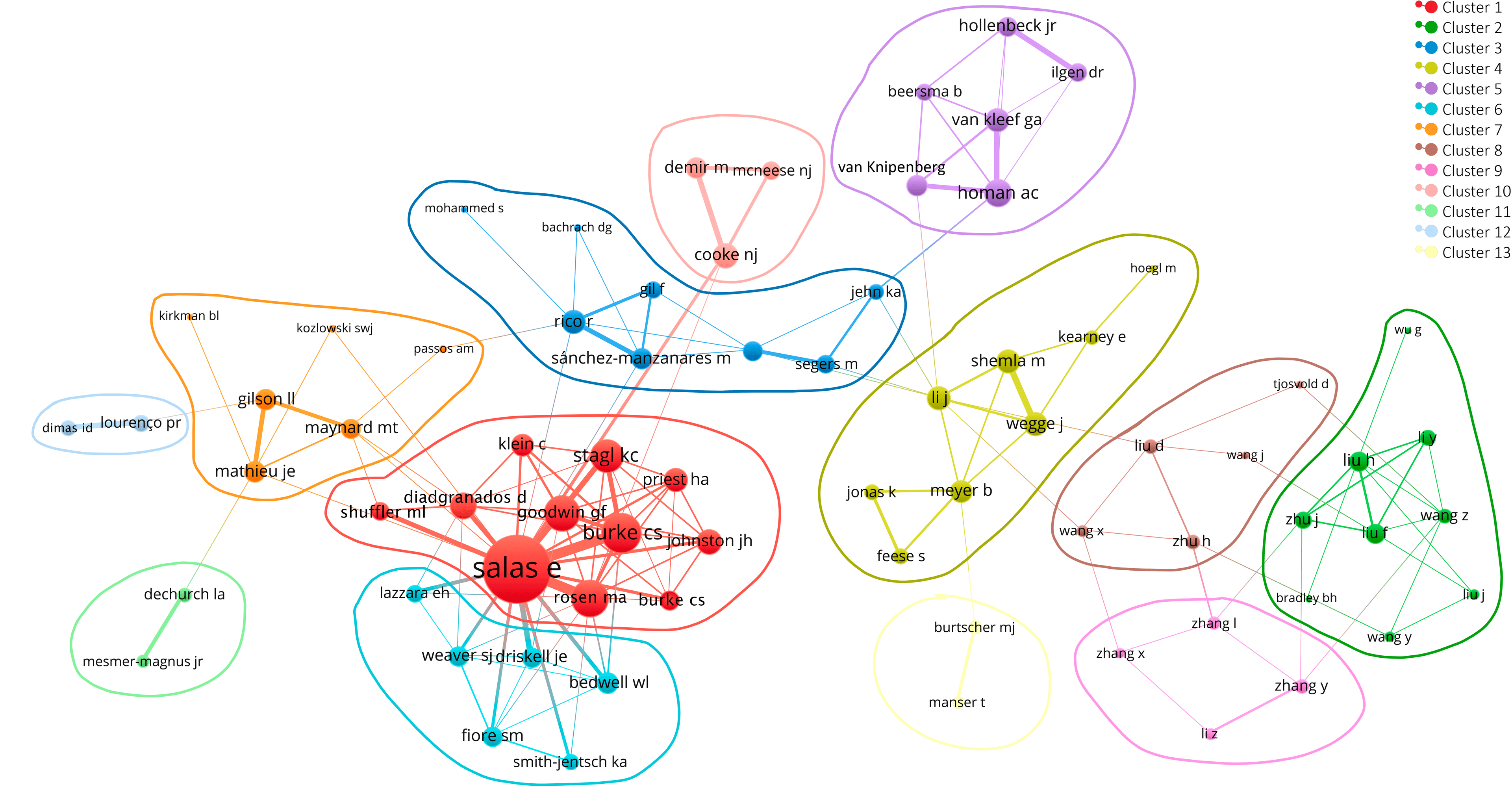
The co-authoring analysis resulted in a collaboration map composed of 13 clusters (see FIGURE 6). We have analysed the frequency and prevalence of the keywords used by the authors of each cluster with the aim of labelling them as leading research groups in the investigation of certain topics. All except four of the top 1% of most influential authors are represented in the collaboration network; the exceptions are Lin C.P., Woolley A.W., Argote L., and Wang Y.
The analysis of keywords per cluster reveals clusters emerging as experts in specific topics. For example, Cluster 1 highlights TEAM TRAINING and TEAM DECISION-MAKING suggest a clear focus on optimizing team preparation and their ability to handle complex decisions. Cluster 2 integrates computational and social sciences, linking ALGORITHMS and DATA MINING with emerging topics like TEAM FAULTLINES and TEAM KNOWLEDGE SHARING. Clusters 3, 4, and 5 share a focus on team diversity, with Cluster 3 emphasizing how diversity and collective mental models influence team performance with keywords like TEAM LEARNING and TEAM COGNITION; Cluster 4, exploring how demographic differences and subgroup dynamics impact cohesion and effectiveness with keywords like TEAM IDENTITY and TEAM FAULTLINES; and Cluster 5 focusing on how individual characteristics such as personality and emotions influence team processes and outcomes with keywords such as EMOTIONS and TEAM PERSONALITY. Cluster 6 emphasizes cognitive adaptability in high-risk contexts, such as long-duration space missions, with keywords like TEAM TRAINING, TEAM ADAPTABILITY, and LONG-DURATION SPACE FLIGHT. Cluster 7 address internal team dynamics and interventions that improve their effectiveness, as evidenced by terms like TEAM PROCESSES, TEAM COHESION, TRANSACTIVE MEMORY SYSTEMS, TEAM INTERVENTION and TEAM TRAINING. Cluster 8 underscores role clarity and adaptability for team success with keywords such as TEAM ROLES, GROUP ROLE ASSIGNMENT, and ROLE-BASED COLLABORATION. Finally, Cluster 10 focus on human-machine teams with keywords such as HUMAN-AGENT TEAMWORK, ARTIFICIAL INTELLIGENCE, and TEAM MENTAL MODELS. Clusters 9, 11, 12, and 13 were excluded from the text as their keyword patterns did not present sufficient clarity or consistency to support robust analysis.
Figure 6: Collaboration network in team effectiveness literature
Which papers can be considered foundational/seminal in the team effectiveness literature?
In the case of team effectiveness, the co-citation network reflects the convergence of multiple theories and lines of research. A first notable finding is that almost the half of landmark publications are integrative in nature, either literature reviews or meta-analyses aimed at synthesizing empirical findings in specific domains, such as team conflict, diversity, trust, or leadership. While some reviews were highly relevant for their ability to condense and mature the literature findings (e.g., Cohen & Bailey, 1997; Knippenberg & Schippers, 2007; Kozlowski & Ilgen, 2006; Mathieu et al., 2008; Williams & O’Reilly, 1998), some of these integrative works also introduced widely accepted theoretical models, such as the evolution from the IPO to the IMOI model (Ilgen et al., 2005), adding an element of originality to their role in shaping the literature.
A relevant finding is the strong presence of research on conflict and diversity, reflecting their cross-cutting influence on team performance. Types of conflict (task, relationship, process) and their effects on cohesion and outcomes have been widely studied. Similarly, diversity, especially through the Categorization-Elaboration Model (CEM), attracts high citation volumes due to its relevance across contexts. Consequently, classic works (e.g., Jehn, 1995; Van Knippenberg & Schippers, 2007) are central in co-citation networks. Notably, foundational frameworks (e.g., McGrath, 1984; Arrow et al., 2000) are absent from top co-cited works, possibly due to diffuse influence or integration into more recent reviews that consolidate and reinterpret core theoretical contributions. However, applying more flexible threshold (number of edges) in the co-citation analysis yields a broader set of landmark publications, indirectly capturing these foundational publications (see Appendix H).
Table 7: Foundational Publications
R | Year | Authors | Type | Title | Link | ||
|---|---|---|---|---|---|---|---|
No records to display | |||||||
Which publications have the highest citation rate relative to the age of the document?
TABLE 8 presents the 10 most highly cited publications on team effectiveness over time. The colour intensity of the squares on the timeline for each publication reflects the number of citations received per year.
The results show that a significant number of publications identified as seminal publications in the co-citation analysis are also among the most cited over time (namely Cohen & Bailey, 1997; De Dreu & Weingart, 2003; Jehn, 1995; Marks et al., 2001; Mathieu et al., 2008; Van Knippenberg et al., 2004, 2007). The productivity analysis also shows additional notable publications, such as the work of Edmondson & Lei (2014) on psychological safety, Gabbett (2016) on the training-injury prevention paradox, and Podsakoff et al. (2009) on organizational citizenship behaviours.
Publications that show strongly increasing amounts of citations in period five (i.e., Edmondson & Lei, 2014; Marks et al., 2001; Van Knippenberg & Schippers, 2007), reflect an interest of team effectiveness researchers to understand the dynamics of (effective) processes and emergent states of teams (e.g., psychological safety as contributor to performance) and the importance of understanding how diversity impacts team performance. Older works from Jehn (1995: on intragroup conflict) and Cohen (1997: a review of teamwork research from 1990-1996), show a decline in the number of citations that they received in period 5.
Table 8: Most Productive Publications (Citations by Year)
R | Publication | 1992 | 1993 | 1994 | 1995 | 1996 | 1997 | 1998 | 1999 | 2000 | 2001 | 2002 | 2003 | 2004 | 2005 | 2006 | 2007 | 2008 | 2009 | 2010 | 2011 | 2012 | 2013 | 2014 | 2015 | 2016 | 2017 | 2018 | 2019 | 2020 | 2021 | 2022 | |
|---|---|---|---|---|---|---|---|---|---|---|---|---|---|---|---|---|---|---|---|---|---|---|---|---|---|---|---|---|---|---|---|---|---|
No records to display | |||||||||||||||||||||||||||||||||
Which keywords, regardless of the pillar to which they belong, have been most used over time in team effectiveness literature?
The analysis of keywords popularity, presented in FIGURE 7, resulted in the construction of an evolutionary ranking of the 15 most used keywords. Different coloured lines highlight the evolution of keyword popularity over time, with grey reserved for keywords lacking other connections.
Team dynamics, especially works on TEAM PROCESSES and their impact on team effectiveness, are consistently present across all five periods. Team diversity and leadership (specifically TRANSFORMATIONAL LEADERSHIP) showed significant initial growth and remained highly used. COMMUNICATION and DECISION-MAKING, while consistently in the top 15, had notable spikes in popularity. TRANSACTIVE MEMORY SYSTEM, however, declined after appearing in period 3. The consistent presence of LITERATURE REVIEWS since the second period likely reflects the need to synthesize the vast array of publications in this field. The increased focus on VIRTUAL TEAMS from the third period onward suggests a growing interest in team effectiveness within non-traditional configurations.
Figure 7: Keyword Frequencies by Period
Selected range: 1992 to 2022
R | Keyword | From 1992 to 2022 | Avg/year | CAGR | |
|---|---|---|---|---|---|
No records to display | |||||